
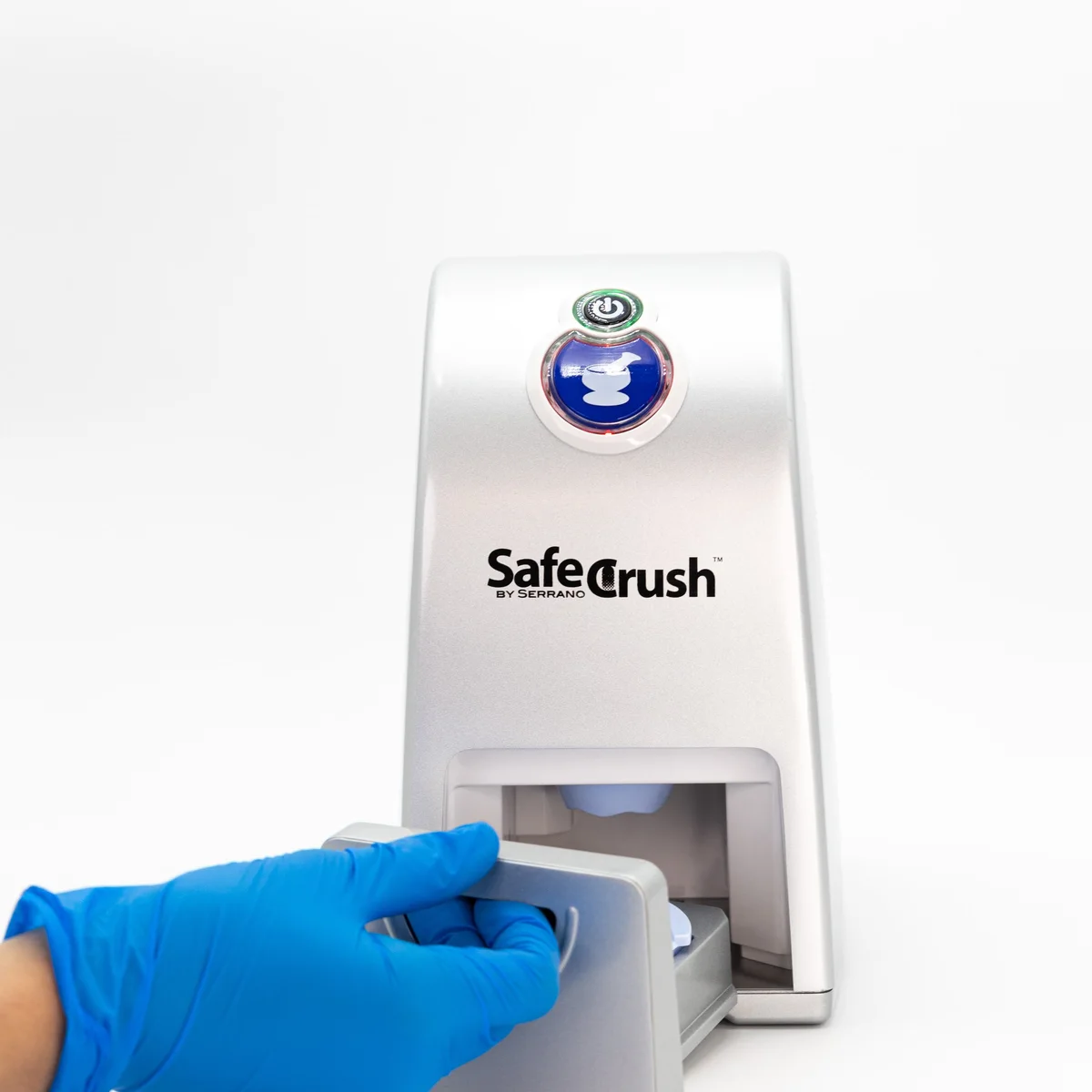
Patients who cannot swallow, or who are fed by tube, often need their tablets crushed. It looks like a simple task, but it carries real risks for the patient and for the nurse. Two questions should come before every crush: is this tablet safe to crush at all, and is the device clean and closed?
Step 1: check before you crush
Slow-release, enteric-coated and some film-coated tablets, and medicines that irritate the mouth or are hazardous to handle, should not be crushed. ISMP warns that crushing or splitting the wrong tablet can be a deadly error, and recommends that splitting and crushing be done only when a suitable whole-tablet strength or an oral liquid is not available.
ISMP also encourages each hospital to maintain and regularly review its own list of oral dosage forms that should not be altered, using package inserts, manufacturer information and drug information resources. Keep that list where crushing happens, and build it into your labels and your software.
Step 2: avoid residue and cross-contamination
Research shows that crushing devices are often shared between patients without cleaning. In one study of 24 crushing devices, about 3% of the drug stayed in a mortar and pestle even with careful use, enough to pass to the next patient if the device is not cleaned. ISMP notes that left-over residue can expose the next patient to a drug they may be allergic to, and prefers crushers that keep the crushed tablet inside a container or pouch.
The same study recommends adding water to the crushed tablet inside the crushing cup and giving it directly, with at least two rinses, so the patient receives the full dose.
Step 3: protect the staff
Crushing creates dust. A study that measured drug levels in pharmacy room dust found higher estimated exposure for a mortar and pestle than for tablet crushers, and found that working on a bench with dust removal and wearing a mask cut exposure sharply. Closed devices and good habits protect the people who crush tablets every day.
What to look for in a pill crusher
- A closed crushing chamber or single-use cup, so powder does not escape and nothing is shared between patients.
- A fine, even powder that mixes easily with water or a swallowing gel.
- Little or no cleaning between uses, and nothing that touches the tablet directly.
- Quiet, fast and easy for nurses with limited hand strength.
A published comparison of tablet crushers notes that the SEVERO uses thin plastic discs (rondels) that separate the crushing pestle from the tablet in the plastic cup, which keeps the device clean and eliminates the risk of cross-contamination.
Related products
Sources
- ISMP: Crushing or splitting the wrong tablet can be a deadly error
- ISMP: Oral Dosage Forms That Should Not Be Crushed (statement)
- Drug loss while crushing tablets: comparison of 24 tablet crushing devices (PMC)
- Occupational exposure of pharmacists to drugs during tablet crushing (Fundamental Toxicological Sciences)
- Performance of Tablet Splitters, Crushers and Grinders (Pharmaceutics, PMC)
This article is general information for healthcare professionals. Always follow your hospital policy, the product information and the advice of your pharmacist.